The Vibe Code Spot
Vibe Coding Project Directory
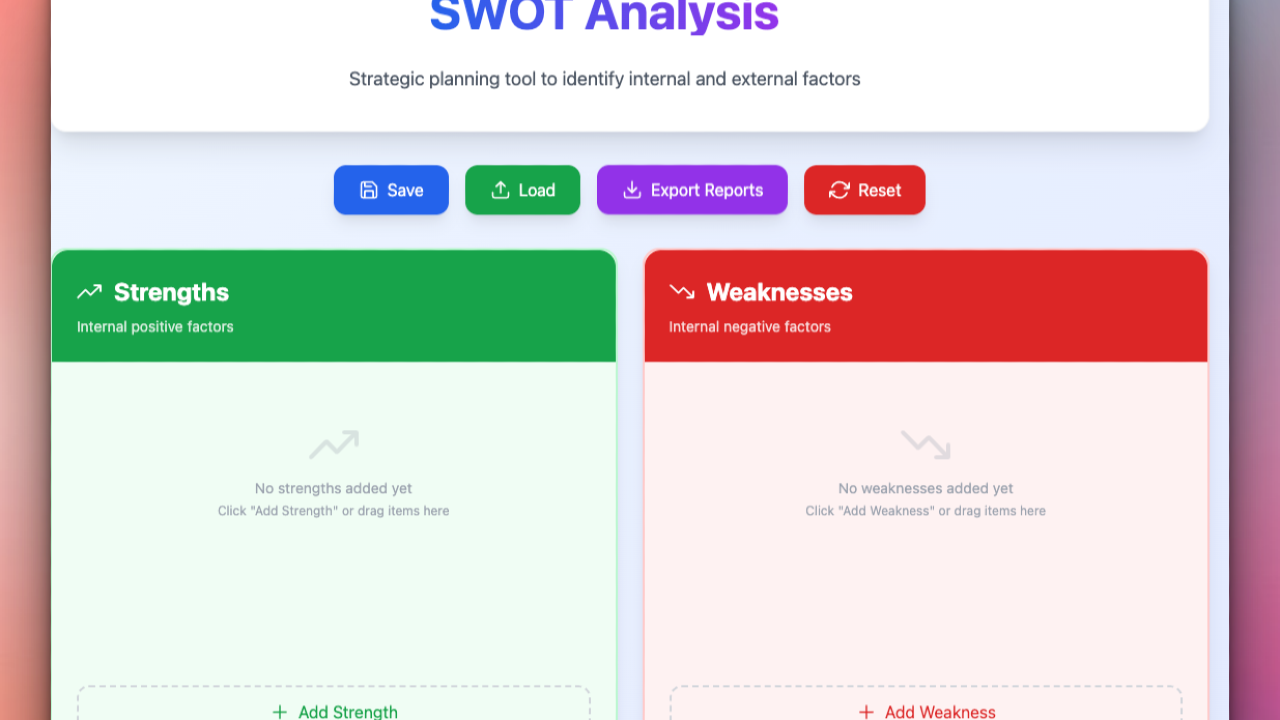
SWOT Analysis Tool
Free online SWOT Analysis Tool — create, edit & export SWOT charts fast.
A SWOT analysis is one of the simplest yet most powerful strategic tools available. It helps teams and individuals look clearly at where they stand now and what could be coming next. This blog explains how to use a web-based SWOT tool (the interface you described), practical tips for filling each section, and ways to turn the output into real decisions.
What this SWOT Analysis tool does — quick overview
This online SWOT interface organizes information into four boxes:
Strengths — internal advantages you can build on Weaknesses — internal limitations you need to manage or fix Opportunities — external trends or openings you can pursue Threats — external challenges that could harm your plans The tool typically supports these actions:
Add items to any of the four lists (Add Strength / Add Weakness / Add Opportunity / Add Threat) Drag and drop to reorder or move items between sections when relevant Save, load, export reports and reset the canvas Upload files to attach supporting documents That structure keeps brainstorming focused, while export and save features let you use SWOT outputs in presentations, plans, or project trackers.
How to use the interface step-by-step
Set the scope and timeframe
Decide what you’re analyzing (company, product, team, campaign) and the time horizon (next quarter, year). Write the scope above the board or in a header so everyone stays aligned. Populate the four boxes
Strengths: Add measurable internal advantages (e.g., “patented process,” “high customer retention — 82%,” “experienced core team”). Weaknesses: Be candid and specific (e.g., “single manufacturing site — high outage risk,” “low marketing budget: $X/month,” “limited analytics capability”). Opportunities: Focus on external shifts you can realistically act on (e.g., “growing demand for sustainable packaging,” “new grant available for R&D,” “partner interest in pilot”). Threats: Note external risks you must monitor or mitigate (e.g., “new competitor with VC funding,” “upcoming regulatory change,” “supply-chain volatility in region X”). Use drag-and-drop strategically
Move items if discussion shows they belong elsewhere. For example, an internal process that’s now an advantage because you fixed it should move from Weakness to Strength. Reorder items to highlight priority: place the highest-impact items at the top of each list. Add evidence and owners
Attach files that justify claims (metrics, market reports, customer feedback). For each item, assign an owner who’s accountable for tracking or acting on it. Export and discuss
Export the report before meetings so stakeholders can review. Use the SWOT to structure a short strategy workshop: decide 2–3 strategic moves based on the matrix. Turning SWOT into action: practical frameworks S-O Strategies (use strengths to seize opportunities)
Example: If you have “recognized product quality” (Strength) and there’s “rising demand for premium eco-products” (Opportunity), plan a co-branded premium eco line. W-O Strategies (use opportunities to mitigate weaknesses)
Example: If you have “limited analytics capability” (Weakness) but “access to government R&D grant” (Opportunity), apply for the grant to build analytics capacity. S-T Strategies (use strengths to reduce threats)
Example: If a competitor is entering (Threat) and you have “strong customer relationships” (Strength), launch a loyalty program to lock-in clients. W-T Strategies (minimize weaknesses to avoid threats)
Example: If “single supplier” (Weakness) and “supply-chain disruption risk” (Threat) exist, diversify suppliers immediately.
Tips for good SWOT inputs
Be specific and measurable: avoid vague phrases like “good team” — write “team with 10+ years’ experience in X.”
Separate internal from external strictly — if it’s inside your organization, it belongs in Strengths/Weaknesses, not Opportunities/Threats.
Invite diverse voices: include sales, ops, finance, and a frontline person for balanced perspective.
Timebox brainstorming: 20–30 minutes per quadrant keeps sessions productive. Revisit the SWOT regularly — quarterly or when major market changes occur.
Common SWOT analysis pitfalls and how this tool helps avoid them
Pitfall: Too many items, no prioritization → Use ordering and owners to focus on top 3–5 items per quadrant.
Pitfall: Mixing symptoms and root causes → Ask “why?” until you find root causes; attach evidence to statements.
Pitfall: No follow-through → Assign owners and set review dates when saving/exporting the report.
Sample outputs you can export from the tool
Printable one-page SWOT summary for leadership
Detailed report with attachments and item owners for project teams CSV or spreadsheet export to integrate with roadmaps and OKR trackers
Quick example (for a small hygiene-products company)
Scope: New antibacterial hand-mist product, 12-month horizon
Strengths
Proprietary mild antiseptic formula (patented) Existing distribution with 250 retail outlets Strong brand recognition among target demographic (age 25–45)
Weaknesses
Low marketing budget ($5k/month) Production limited to single plant No in-house digital advertising expertise
Opportunities
Increased public focus on hygiene post-pandemic Retailers asking for compact travel-size formats Government subsidy for small manufacturers adopting sustainable packaging
Threats
New low-cost competitor imports from region X Rising raw material costs Regulatory changes tightening active-ingredient limits Suggested actions
S-O: Launch travel-size line using existing distribution; highlight patented mild formula. W-O: Apply for sustainability subsidy to fund packaging redesign and expand production capacity. S-T: Use brand recognition to run targeted promotions to defend shelf space. W-T: Start supplier diversification plan to mitigate raw-material cost shocks.
Final thoughts
The strength of a SWOT is not in filling boxes — it’s in translating the insights into prioritized, owned actions. Use the tool to capture evidence-backed inputs, assign owners, and export clear reports for follow-up. Revisit the canvas as new data arrives, and keep the board lean: the best strategic moves come from a few focused, well-executed initiatives.